Industrial Strainers
Essential protection for pumps, valves, heat exchangers and instrumentation. Y strainers, basket strainers, cartridge filters and self-cleaning strainers to trap solid impurities and extend plant life.
Why install strainers in systems
Every hydraulic system contains impurities: pipe manufacturing residues, rust scale, sand, sediment, fibres and various particles. If not intercepted, these contaminants cause accelerated pump wear, blocking of control valves, clogging of heat exchangers, damage to instrumentation and malfunction of solenoid valves and steam traps.
Industrial strainers are the first line of defence: installed upstream of critical components, they retain solid particles and protect the plant. Periodic strainer maintenance (much simpler and cheaper than repairing downstream components) ensures reliable, long-lasting operation.
Roffia distributes strainers in cast iron, steel, stainless steel and plastic materials, with filtration grades from 40 to 500 mesh (400 microns down to 25 microns). For special requirements, we supply cartridge filters and self-cleaning systems. All strainers are available with replacement filter elements.
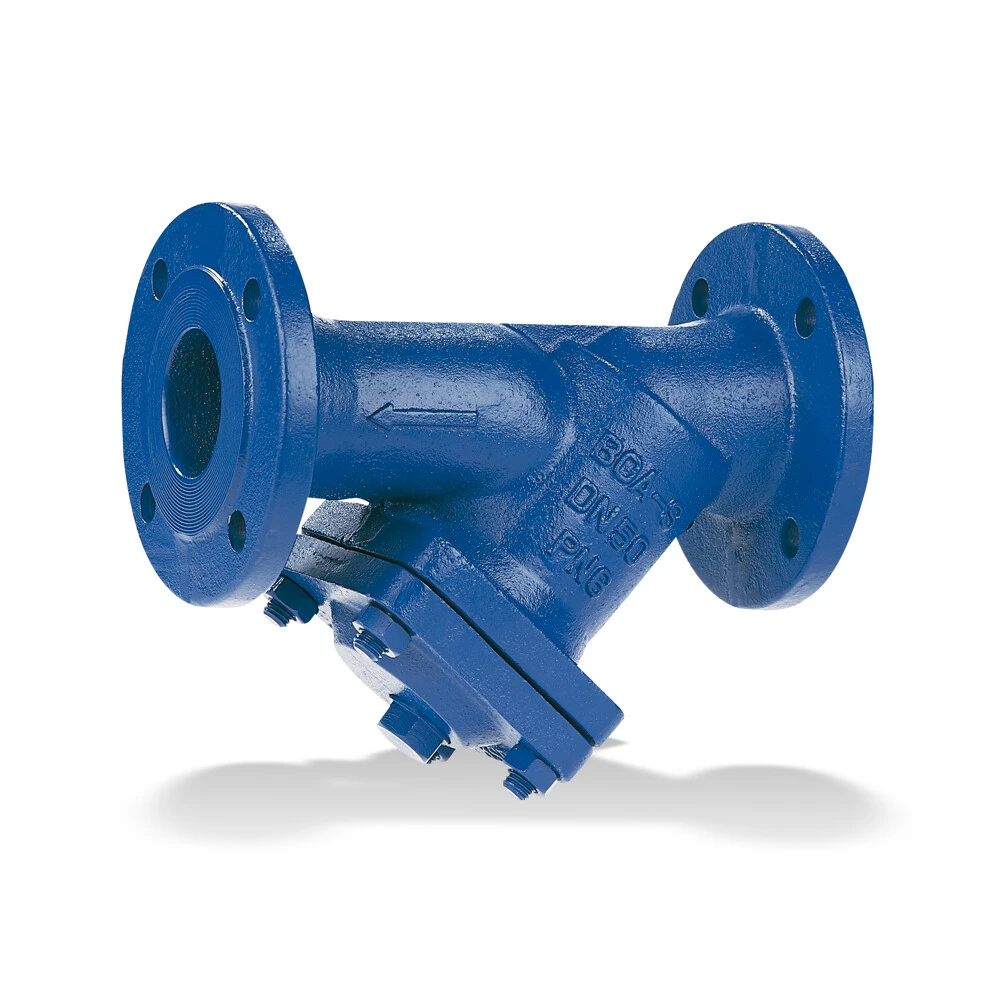
Y strainers (wye strainers)
- Compact, economical, easy maintenance
- Horizontal or vertical installation
- DN 10–300, PN 16–40
- Cast iron, steel, stainless steel, bronze
- Ideal for general protection
- Connections: threaded, flanged, socket weld
Basket strainers
- Greater dirt-holding capacity
- Top-removable basket
- DN 25–400+
- For heavily contaminated fluids
- Low pressure drop
- Less frequent maintenance
Cartridge filters
- Fine filtration (1–100 microns)
- Replaceable cartridges
- For instrumentation and critical processes
- Housing in stainless, PP, PVDF
- Cartridges: paper, polypropylene, sintered stainless
- Ideal for ultra-pure water, solvents
Self-cleaning strainers
- Automatic cleaning without plant stoppage
- Programmable backwash cycle
- For continuous 24/7 service
- Industrial water, cooling towers
- DN 50–600
- Manual, timer or ΔP control
Duplex strainers
- Two strainers in parallel with changeover valve
- Maintenance without plant stoppage
- Switch flow to other strainer
- For critical continuous processes
- Available in Y and basket types
- DN 25–200
Typical applications
Pump protection
A Y or basket strainer upstream of the pump retains coarse solids that could damage impeller and seals. This is the simplest and most effective measure to extend the life of centrifugal, positive displacement and metering pumps. Typical grade: mesh 20–80.
Control valve protection
Control valves have precision plugs and seats that can be damaged by even small particles. An upstream strainer with mesh 80–100 prevents blockages, leaks and premature wear, ensuring stable and accurate regulation.
Heat exchanger protection
Plate heat exchangers have narrow channels prone to clogging. A basket strainer with mesh 100+ upstream prevents solids build-up and maintains thermal efficiency. For shell-and-tube exchangers, filtration is less critical but still recommended.
Steam and condensate systems
In steam networks, weld spatter and rust scale can block steam traps, safety valves and instrumentation. Stainless steel Y strainers installed upstream protect these critical components, reducing downtime and maintenance costs.
Roffia strainer range
DN 15–200, PN 16
DN 10–100, PN 16–40
DN 25–300, cast iron/stainless
For vertical installations
Steel, high temperature
Housing + cartridges 1–100 μm
DN 50–200, timer/ΔP
Replacements mesh 20–500
Frequently asked questions
What is the difference between Y strainers, basket strainers and cartridge filters?
How do I choose the strainer mesh (filtration grade)?
Strainers cause pressure drop — how can I minimise it?
What materials are available for industrial strainers?
How often should a strainer be cleaned and how?
Request an industrial strainer quote
Please provide fluid, flow rate, required filtration grade and operating conditions. We will recommend the optimal strainer with a prompt quotation and replacement elements.