Diaphragm Steam Pressure Reducers
Compact, cost-effective pressure control for individual equipment and small to medium steam loads. Simple direct-acting design with minimal maintenance.
Simple, reliable pressure reduction
Diaphragm pressure reducing valves use a flexible membrane to sense downstream pressure, balanced against an adjustable spring. No external pilot, no auxiliary power — just physics.
The result: a compact, reliable valve ideal for individual process equipment, steam tracing, small heating loads and applications where space is limited. Maintenance is straightforward — diaphragm and seat can be replaced without removing the body from the line.
Roffia distributes Spirax Sarco DP and DRV series — proven designs with millions of installations worldwide.
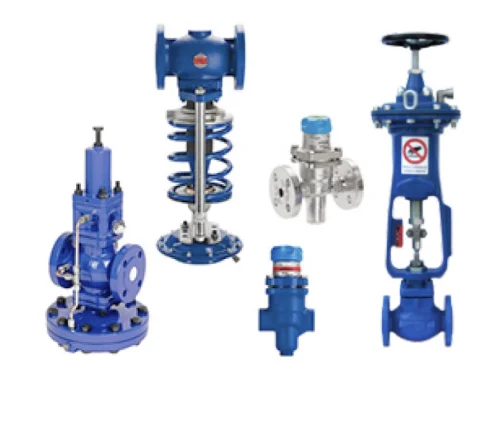
Technical specifications
DP Series (compact)
- Max inlet pressure: 17 bar
- Outlet pressure: 0.1 – 10 bar (adjustable)
- Temperature: up to 200°C
- Connections: Screwed DN 15-50
- Accuracy: ±0.3 bar
DRV Series (medium capacity)
- Max inlet pressure: 17 bar
- Outlet pressure: 0.2 – 10 bar (adjustable)
- Temperature: up to 232°C
- Connections: Flanged DN 15-80 (PN 16/25)
- Accuracy: ±0.2 bar
Advantages
- ✓ Compact — fits in tight spaces
- ✓ Simple — fewer parts to fail
- ✓ Cost-effective — lower initial cost
- ✓ Easy maintenance — in-line service
- ✓ Self-contained — no external sensing lines
Considerations
- • Droop: outlet rises 0.2–0.5 bar with flow
- • Capacity limited vs pilot-operated
- • For high accuracy, use pilot-operated
- • Best for stable, predictable loads
Applications
Individual equipment
Single jacketed vessels, small heat exchangers, autoclaves. Dedicated pressure for each unit.
Steam tracing
Process pipe tracing where low-pressure steam prevents freezing or maintains product temperature.
Small heating loads
Unit heaters, coils, humidifiers with steady demand and moderate accuracy requirements.
Domande frequenti
How does a direct-acting diaphragm pressure reducer work?
When should I choose a diaphragm reducer over a pilot-operated one?
What is "droop" in a direct-acting pressure reducer?
What is the maximum temperature for diaphragm steam reducers?
Which Spirax Sarco models are diaphragm reducers?
Can diaphragm reducers be used for air and gases?
Need diaphragm steam pressure reducers?
Contact us for sizing assistance or stock availability. We carry the most common DP and DRV sizes for fast delivery.