Safety Valves & Pressure Relief Valves
The last line of defence against catastrophic overpressure. PED-certified safety and relief valves for steam, gas, compressed air and liquid service in boilers, pressure vessels and process pipelines.
The role of safety valves in industrial plants
Safety and relief valves are automatic protection devices — they require no external power, control signal or operator intervention. They are the final layer of overpressure protection for pressure vessels, boilers, steam generators, pipelines, heat exchangers and process reactors. If all other control and protective systems fail and pressure in the protected equipment rises above the set pressure, the safety valve opens automatically to discharge fluid and reduce pressure to a safe level.
In Italy and throughout the EU, the installation of appropriate safety valves on pressure equipment is a legal requirement under the Pressure Equipment Directive PED 2014/68/EU, the successor to the ISPESL regulations. Equipment covered includes: steam boilers and hot-water generators, pressure vessels (autoclaves, compressor tanks, reactors), steam and compressed air distribution networks, hydraulic and pneumatic systems above 0.5 bar, and cryogenic and LPG storage.
Roffia carries a comprehensive range of spring-loaded safety valves (threaded DN 15–50 and flanged DN 25–200) and pilot-operated valves, all PED-certified with CE marking and full documentation. We also offer sizing and selection as a free technical service.
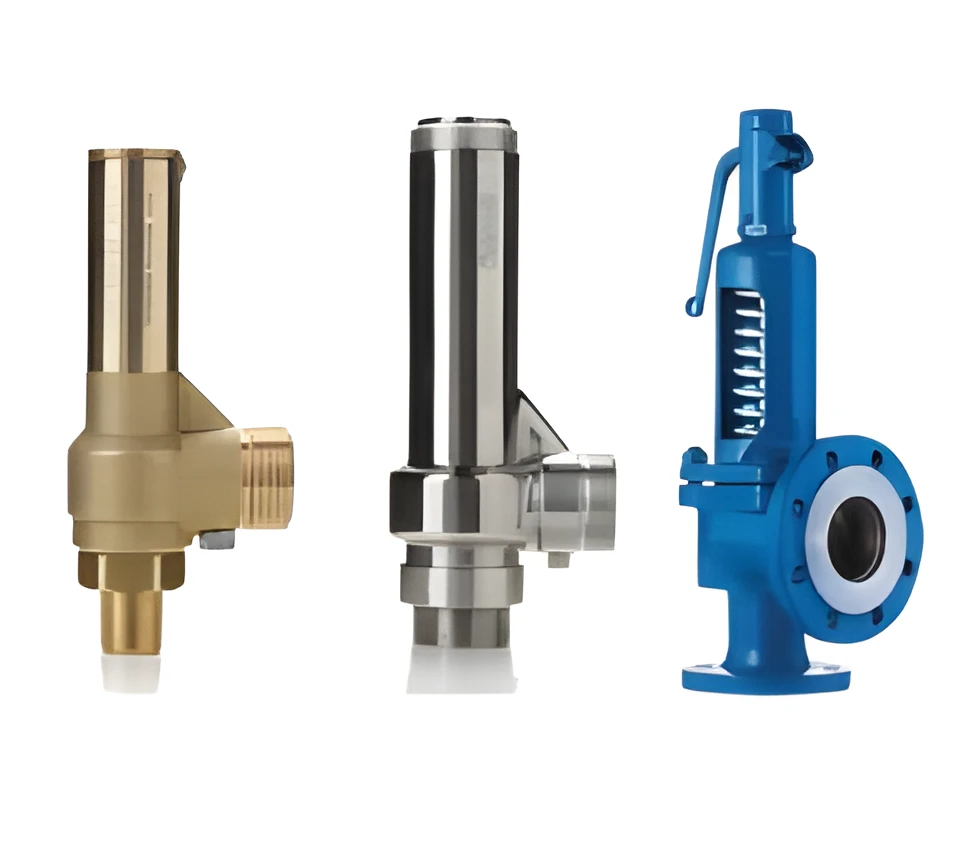
Spring-loaded safety valves
- Direct-acting, no external power
- Fluids: steam, gas, air, liquid
- Set pressure range: 0.5 to 250 bar
- Connections: threaded BSP/NPT, flanged EN/ANSI
- Body: cast iron, SS, bronze, carbon steel
- Certified to EN ISO 4126-1, PED CE marked
Pilot-operated safety valves
- Tight shut-off up to 98% of set pressure
- Large capacities in compact body
- Very low simmer / leakage before set point
- For steam, gas and vapour service
- Used on large boilers and steam headers
- Modulating or snap-action pilot
Thermal and hydraulic relief
- Thermal relief: liquid expansion in blocked pipe sections, closed loop circuits
- Hydraulic relief: pump discharge protection, hydraulic power units
- Body: brass, SS, carbon steel
- Very compact, direct-acting
- Set pressures from 4 to 400 bar
Applications by sector
Steam boilers and generators
Every steam boiler in Italy must be equipped with at least one certified safety valve sized to relieve the full boiler output at set pressure. Roffia supplies spring-loaded safety valves from DN 15 (threaded, for small package boilers) to DN 200 (flanged, for large industrial steam generators), all CE-marked to PED Category III or IV as required by INAIL/ISPESL registration. Set pressure range: 0.5 to 40 bar saturated steam.
Compressed air systems
Compressed air receivers, ring mains and downstream equipment require relief valves set at or below the MAWP of the weakest component in the system. Typical set pressures for industrial compressed air are 7–16 bar(g). Roffia stocks compact, direct-acting safety valves in bronze and stainless steel for this service, with certified capacity data for air and nitrogen.
Process vessels and reactors
Chemical reactors, autoclaves, distillation columns and pressure vessels in the chemical and pharmaceutical industry require carefully engineered safety valve installations, including proper inlet and outlet piping, rupture discs upstream and tail-pipe calculations to limit back pressure. Roffia supplies full documentation packages for these applications including sizing calculations, certificates and MTRs.
Hot water and thermal circuits
Expansion vessels and boilers generating hot water above 110 °C (pressure hot water) must be protected by safety valves capable of preventing dangerous flashing. Thermal relief valves are also installed on every section of pipework that can be isolated while hot, preventing catastrophic failure of pipe flanges and fittings due to liquid expansion (thermal relief). See also: our page on steam trap maintenance.
Frequently asked questions
What is the difference between a safety valve and a relief valve?
What does PED certification mean for safety valves, and is it mandatory?
How do you correctly size a safety valve?
What is a pilot-operated safety valve and when is it used?
Safety valve sizing and supply
Provide your equipment data (design pressure, MAWP, fluid, temperature, relieving capacity required) and we perform the sizing calculation at no cost. We then supply the correct PED-certified valve with full documentation.