Pressure Reducing Valves

Maintain stable downstream pressure in steam, compressed air and water systems. Direct-acting and pilot-operated designs for every flow rate and accuracy requirement.

Why pressure reduction is essential

Industrial utilities — steam, compressed air, natural gas, water — are often generated or supplied at higher pressures that are efficient for distribution but too high for safe and economical use at the point of consumption. Over-pressure not only risks damage to equipment and pipework, it wastes energy: compressed air leakage rate increases with the square of pressure; steam at excess pressure saturates the heat exchanger and reduces efficiency; excess water pressure accelerates valve and fitting wear.

A correctly sized and installed pressure reducing valve (PRV) step-down the supply to a stable working pressure, protecting downstream equipment, conserving energy and ensuring repeatable process conditions. The primary energy saving benefit in steam systems is particularly significant — reducing steam pressure from 8 bar to 3 bar reduces the latent heat content but also increases the dryness fraction and reduces flash steam losses at steam traps, improving overall system efficiency. See our guide to energy efficiency in industrial plants.

Roffia stocks PRVs from Spirax Sarco (steam-specialist designs) and Caleffi (water and HVAC-optimised), as well as direct-acting PRVs from a range of established European manufacturers, available for same-day dispatch from Cremona.
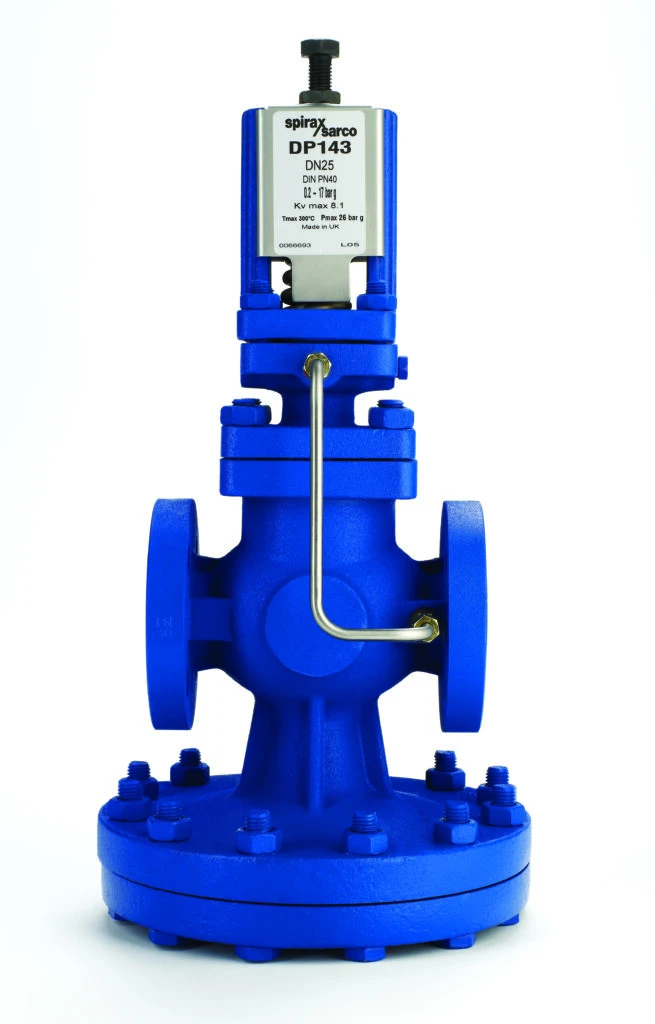
Pressure reducing valves — Roffia srl

PRVs for steam

  • Bronze body, stainless internals
  • DN 15–80 threaded; DN 50–150 flanged
  • Inlet: 0.5–18 bar; outlet: 0.2–8 bar
  • Balanced-port design (inlet-pressure insensitive)
  • Direct-acting and pilot-operated models
  • Designed to BS EN ISO 6945 / Spirax Sarco BRV / PRV

PRVs for water and heating

  • Brass and stainless steel bodies
  • DN 15–50 (1/2" to 2") domestic and commercial
  • Outlet pressure range: 1.0–6.0 bar adjustable
  • Includes filter screen on many models
  • Caleffi series 535, 536, 553 in stock
  • Combinations with check valve and gauge

PRVs for compressed air and gas

  • Inlet pressures to 16 bar (air), 0.3–4 bar (gas)
  • Diaphragm-controlled, balanced seat
  • Integral relief valve on some models
  • Aluminium, zinc alloy and SS bodies
  • With/without gauge and filter regulator
  • Lockable adjustment cap for tamper resistance

Complete PRV station assemblies

For professional installations, Roffia can supply complete prefabricated PRV station assemblies on a single pipe spool, ready to bolt in: upstream isolation valve + strainer (Y-type) + PRV + downstream pressure gauge + safety valve + downstream isolation valve. Twingles ("twin parallel" arrangements with a bypass) are available for continuous-service systems requiring maintenance without shutdown. All assemblies are tested and documented before dispatch, saving installation time and ensuring correct specification.

Contact our technical team for custom PRV station design — we provide piping sketches, material specifications and sizing calculations as part of our supply service.

Frequently asked questions

How does a pressure reducing valve work?
A pressure reducing valve (PRV) is a self-contained, automatic control device that reduces a higher upstream (inlet) pressure to a lower, stable downstream (outlet) pressure, regardless of changes in upstream pressure or downstream demand. In a direct-acting PRV, a spring-loaded diaphragm assembly senses the downstream pressure. When downstream pressure drops below the set point (due to increased demand), the spring pushes the valve plug open, allowing more flow. When downstream pressure rises to set point, the diaphragm compresses the spring and the plug throttles toward closed — this happens continuously, in a dynamic balance. The set point is adjusted by screwing the spring housing in or out. A balanced pressure seat arrangement makes the valve's opening force independent of inlet pressure — essential when upstream supply pressure fluctuates. PRVs are available in direct-acting (smaller flows, simpler) and pilot-operated (large flows, greater accuracy, less droop) versions.
What is the difference between a direct-acting and a pilot-operated PRV?
Direct-acting pressure reducing valves use a single spring-and-diaphragm mechanism directly connected to the valve plug. They are compact, simple, require no external sensing lines and are cost-effective. However, they exhibit "droop" — the actual downstream pressure decreases slightly from the set value as flow increases, because the increased spring compression needed to open the main plug causes the sensing diaphragm to register a slightly lower pressure. Droop is typically 0.3–1 bar across the normal flow range. Direct-acting PRVs are appropriate for small-to-medium flow rates, domestic systems, steam utilities and heating circuits. Pilot-operated pressure reducing valves use a small pilot valve to sense downstream pressure and use the inlet pressure energy to actuate the main (large) valve. This arrangement provides: (1) much higher accuracy (droop typically 0.1–0.2 bar only); (2) capability to handle very high flow rates with a compact main valve body; (3) ability to handle large pressure drops without cavitation. Pilot-operated PRVs are specified for large-scale steam systems, industrial process water, air systems and wherever high accuracy is required.
What applications require pressure reducing valves?
PRVs are required wherever a high supply pressure must be stepped down to a safe, efficient working pressure for downstream equipment or processes: Steam distribution — steam is generated at high pressure (e.g., 10 bar) for efficient transport but must be reduced to working pressure (1–3 bar) at each user point. Steam PRVs are critical for steam system efficiency and equipment protection. Compressed air systems — central compressors may supply at 8–12 bar; individual machines, instruments and tools may require 4–7 bar. PRVs at each branch or machine protect equipment and reduce energy waste. Hot and cold water systems — mains supply may be 6–8 bar; building and domestic systems typically require 2–3.5 bar. A PRV at the building entry protects plumbing fixtures and reduces water waste. Industrial process systems — chemical reactors, autoclaves and precision manufacturing equipment all need stable, accurate supply pressures. Gas distribution — natural gas and other gases require multi-stage pressure reduction from high-pressure transmission to low-pressure utilisation.
Do pressure reducing valves need a strainer upstream?
Yes — always. Every PRV installation should include a strainer (Y-type or basket strainer) upstream of the valve, as close as practical. The valve's trim — the plug, seat and balanced pressure port — works with very small clearances and is sensitive to solids, scale particles and pipeline debris. Even a very small particle can lodge under the plug seat and cause the valve to remain partially open, resulting in downstream overpressure (a potentially dangerous condition if safety valves are not also correctly sized). The strainer mesh size should be selected according to the manufacturer's recommendation for the valve size — typically 0.3–0.5 mm mesh for steam and air, 0.5–1.0 mm for water. After initial commissioning, the strainer should be cleaned within the first few weeks of operation to remove installation debris. Roffia stocks complete PRV station assemblies including strainer, isolation valves, pressure gauges and safety valve for immediate installation.

Size and supply your PRV station

Send us: fluid type, max inlet pressure, required outlet pressure, max flow rate and any space constraints. We size the PRV, recommend appropriate accessories and supply the complete assembly.

Privacy Policy Cookie Policy