Food-Grade & Sanitary Valves
Hygienic butterfly and ball valves in AISI 316L stainless steel for food, dairy, beverage, wine and pharmaceutical manufacturing. Certified for food contact per EU Regulation 1935/2004.
Hygienic design for food safety
In food and beverage manufacturing, the piping and valve system is a critical food safety element. Any valve that comes into contact with the food product — or with cleaning solutions used in CIP/SIP cycles — must be designed and certified to prevent contamination. This means: materials that do not migrate harmful substances into food; internal surfaces that can be completely cleaned by CIP without dismantling; no dead legs or crevices where product residues and microorganisms can accumulate; and seal materials that are soft-food-contact approved and chemically resistant to both the food product and the cleaning agents (typically CIP chemicals: alkaline NaOH solutions, acid HNO₃/HCl solutions and steam).
Roffia serves the food and beverage sector with a complete range of hygienic valves from manufacturers whose designs comply with EHEDG (European Hygienic Engineering and Design Group) guidelines and EU Regulation 1935/2004. Our range covers dairy (milk, yoghurt, cheese, cream), beverage (soft drinks, juice, beer, wine), bakery, confectionery and fine chemicals / pharmaceutical.
Read our article on valves for the food industry: standards and selection guide for a comprehensive technical overview.
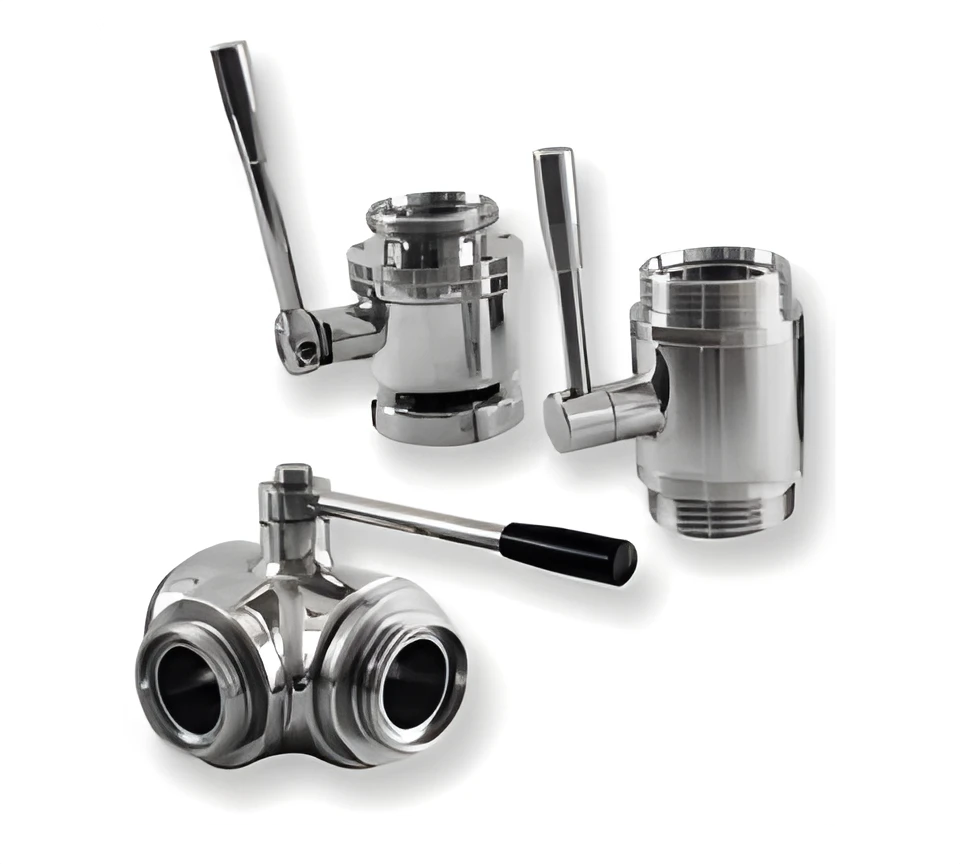
Sanitary butterfly valves
- Body and disc: AISI 316L
- Seat: EPDM, PTFE, silicone, VMQ
- DN 25–300, PN 10–16
- Connections: tri-clamp, hygienic flange, weld-end
- Manual lever, pneumatic, electric actuation
- Surface finish Ra ≤ 0.8 µm standard
Sanitary ball valves
- Full-bore, DN 15–100
- Body and ball: AISI 316L
- Seats: PTFE (standard), PEEK (high temp)
- Seals: EPDM or FKM
- Tri-clamp or threaded ends
- Pneumatic actuated assemblies in stock
Standards and certifications
- EU Regulation 1935/2004 (food contact)
- EHEDG guidelines (hygienic design)
- 3-A Sanitary Standards
- EC1935 / FDA 21 CFR for seals
- ISO 2852 (tri-clamp fittings)
- DIN 32676 (hygienic fittings)
Food industry applications
Dairy industry
Milk, cream, yoghurt and cheese production require EHEDG-compliant sanitary butterfly valves on pasteurisers, homogenisers, separator lines and CIP circuits. EPDM seats are standard for dairy duty; PTFE is specified for products with high fat content or aggressive CIP chemicals. Pneumatic spring-return actuators ensure automatic closure on CIP initiation.
Wine and beverage
Winemaking uses AISI 316L butterfly valves for must, wine and lees lines from crush to bottling. EPDM seats resist tartaric acid and sulfur dioxide. Beer brewing requires valves rated for hot-wort transfer (80–100 °C) with EPDM or silicone seats. Carbonated beverages need valves rated for CO₂ partial pressure.
Pharmaceutical and cosmetics
Pharmaceutical manufacturing (APIs, oral liquids, topicals) demands Ra ≤ 0.4 µm finish on all product-contact surfaces, full traceability of steel heats and elastomer lots, and SIP capability (steam sterilisation). Valves must be designed for zero dead-leg to prevent contamination between batches. Roffia sources specialised aseptic valves for pharma applications on request.
Bakery and confectionery
Handling of chocolate, syrups, dough and batter requires full-bore valves (to prevent blockage by viscous products), jacketed versions (to maintain product temperature and prevent solidification) and seats in silicone (approved for dry and semi-dry food products, high temperature compatible). Knife gate valves are also used for starch and flour slurries.
Frequently asked questions
What European regulations govern food-grade valves and hygienic fittings?
What materials are food-grade valves made from, and why AISI 316L?
What is a "sanitary finish" and what surface roughness (Ra) is required?
What types of food-grade valves does Roffia supply?
Food-grade valve supply
Tell us your application (product, CIP chemicals, temperatures), required DN, connection type and actuation. We supply certified, documented food-grade valve assemblies compliant with EU 1935/2004 and EHEDG.