Balancing Valves
Hydraulic balancing for efficient and comfortable systems. Manual (static) and automatic (PICV) valves to ensure design flow at every terminal, eliminating imbalances, noise and energy waste.
Why hydraulic balancing is essential
In a heating or cooling system with multiple terminals (radiators, fan coils, AHUs, radiant panels), water tends to flow preferentially through the circuits of lowest resistance — those closest to the pump or with shorter pipework. The most distant terminals receive less flow than required, becoming underserved (cold rooms in winter, hot in summer), while nearby terminals are overserved with wasted energy and noise.
Balancing valves solve this problem by introducing an adjustable head loss in each circuit, equalising resistances and ensuring every terminal receives exactly its design flow. The result: uniform comfort throughout the building, energy savings (no excessive flows), quiet operation (no noise from excessive velocity).
Roffia distributes manual and automatic balancing valves from Caleffi and Danfoss. We offer technical support for selection and sizing based on your project.
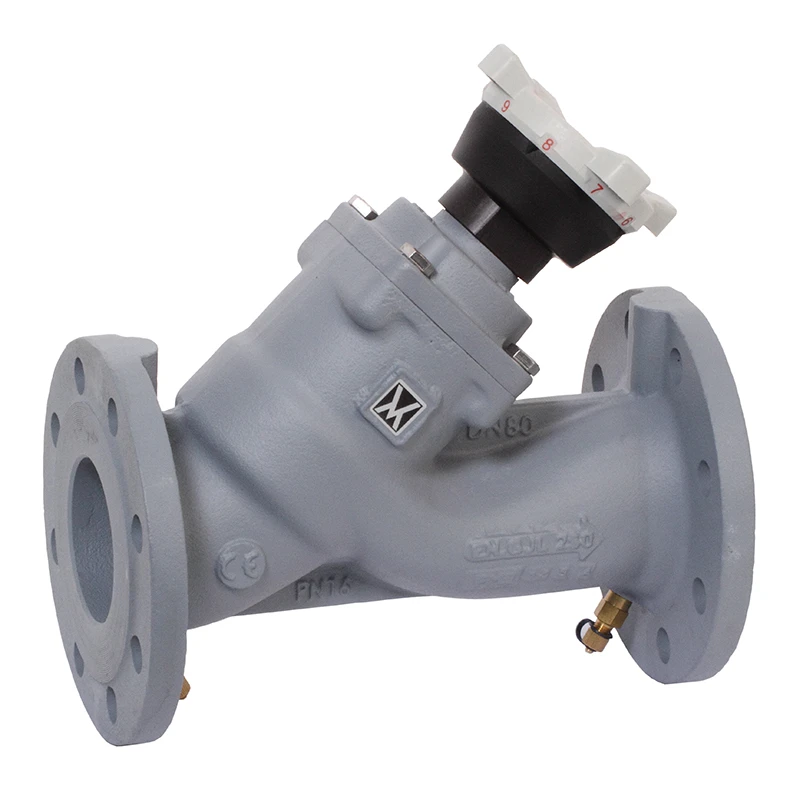
Manual (static) valves
- Manual adjustment with graduated handwheel
- Pressure taps for flow measurement
- Tamper-proof locking
- Brass or cast iron body
- DN 10–150, PN 16–25
- Economical, ideal for stable systems
Automatic valves (PICV)
- Pressure independent (ΔP compensated)
- Max flow set on dial
- Integrated 2-way control
- Simplified commissioning
- DN 15–50 (DN 65–150 on request)
- For fan coils, AHUs, variable-flow circuits
Differential pressure regulators
- Maintain constant ΔP in circuit
- Mounted at riser return
- Eliminate noise from excess ΔP
- Complement to manual valves
- DN 15–100
- Caleffi Series 145, Danfoss ASV
Benefits of correct balancing
- Uniform comfort — every room reaches desired temperature
- Energy savings — no excessive flows in nearby circuits
- Quiet operation — eliminates noise from high velocity and turbulence
- Longer component life — pumps and valves work at optimal duty
- Regulatory compliance — meets UNI EN 14336, energy incentive requirements
Commissioning instruments
- Differential manometer — measures ΔP at valve taps
- Ultrasonic flow meter — non-invasive verification
- Calculation software — Caleffi Idraulico, Danfoss Tools
- Balancing apps — smartphone-guided commissioning
- Roffia provides instruments and technical support
Typical applications
Central heating systems
Apartment buildings, hospitals, schools and offices with riser distribution require balancing valves on each riser to ensure all floors receive the correct flow. PICVs on terminals (radiators, fan coils) ensure balancing even at partial loads.
Cooling and HVAC systems
In systems with air handling units, fan coils and room terminals, balancing is critical for energy efficiency. PICVs allow flow to vary with load without unbalancing adjacent circuits.
Primary and secondary circuits
In systems with hydraulic separation (headers, separators), balancing valves on the secondary circuit ensure each zone receives the necessary flow regardless of other zones' operation. ΔP regulators on risers complete the system.
District heating and BMS
District heating substations require balancing valves to adapt flow to building demand. In BMS systems, PICVs with integral actuators enable remote control with position and flow feedback.
Roffia balancing valve range
Manual, DN 10–50
Large systems, DN 65–150
Automatic, adjustable ΔP
Manual, high precision
PICV, variable flow
Automatic ΔP regulators
Manometers, software, fittings
Sizing and selection
Frequently asked questions
What is the difference between static and dynamic balancing valves?
What does PICV mean and when is it preferable to a manual balancing valve?
How is hydraulic balancing performed with manual valves?
Which balancing valve brands are most common and does Roffia carry them?
Is hydraulic balancing required by law?
Request a balancing valve quote
Send us your system schematic with design flows and head losses. We will propose the optimal solution — manual, automatic or mixed system — with a detailed quotation.