Industrial Solenoid Valves
Automated on-off control for water, compressed air, steam, gas and process fluids. Direct-acting and pilot-operated. Interchangeable coils, ATEX versions, wide DN range and voltages.
How solenoid valves work
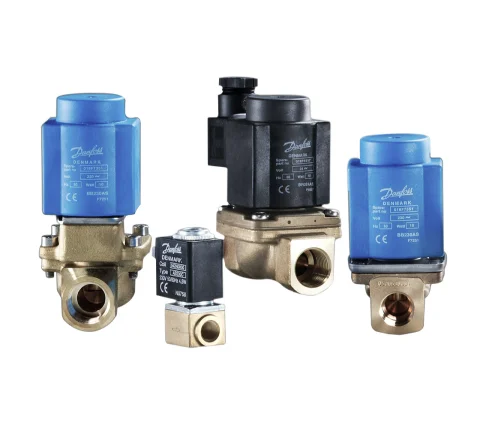
Solenoid valves are electrically operated valves that use a solenoid (electromagnet) to open or close the fluid passage. When the coil is energised, the magnetic field attracts the movable core, shifting the plunger from its seat and allowing fluid to flow (NC configuration) or vice versa closing it (NO configuration).
They are the fundamental component of every industrial automation system: they receive an electrical signal from PLCs, thermostats, pressure switches, timers or sensors and translate this command into mechanical opening or closing of the flow. Response is fast (typically 10–100 ms), control is binary (on-off) and reliability is high for millions of cycles.
Roffia distributes solenoid valves in brass, stainless steel and engineered polymer, with coils in various voltages (24 V DC, 230 V AC, 110 V AC) and protection ratings up to IP67. Available in 2/2 way (isolation), 3/2 way (diversion), normally closed and normally open configurations.
Direct-acting
- Opens with solenoid force alone
- Works even at zero pressure
- Ideal for viscous fluids and vacuum
- Typically DN 6–25
- Very fast response times (<20 ms)
- Higher power consumption
Pilot-operated (servo-assisted)
- Solenoid pilot + main plunger
- Requires minimum differential (0.3–0.5 bar)
- High flow rates with compact coils
- DN 10–80 and beyond
- Low power consumption
- Ideal for water, air, pressurised fluids
Types and configurations
- 2/2 way NC — isolation, fail-safe closed
- 2/2 way NO — fail-safe open
- 3/2 way — diversion/mixing
- Bi-stable (latching) — holds position without power
- Proportional — modulating opening 0–100%
Body materials
- Brass CW617N — water, air, neutral gases, oil
- Stainless steel AISI 316 — steam, aggressive fluids, food
- Engineered polymer (PA, PVDF) — chemical fluids, demin water
- Cast iron / Carbon steel — high flow, high pressure
Seal materials
- NBR (Buna-N) — air, water, mineral oils (–10/+90 °C)
- EPDM — hot water, steam, oxidising fluids (–30/+140 °C)
- FKM (Viton) — high temperatures, solvents, synthetic oils (–15/+180 °C)
- PTFE — universal, maximum chemical resistance (–40/+200 °C)
Typical applications
HVAC and building automation
Automatic control of hot and cold water in HVAC systems, fan coils, radiators, irrigation systems and sanitary circuits. Solenoid valves receive commands from room thermostats, BMS systems and timers to manage building comfort and energy efficiency.
Compressed air systems
Control of pneumatic cylinders, actuators, tools and automatic machines. 3/2 and 5/2 way solenoid valves control piston movement in both directions. Fast response times (<50 ms) and high switching frequency are essential for production efficiency.
Process plants and steam
Control of process steam, condensate and thermal fluids in chemical-pharmaceutical, food and manufacturing plants. Steam service requires specific solenoid valves with PTFE/FKM seals and stainless steel bodies.
Fire protection and safety systems
NC solenoid valves on sprinkler and deluge circuits: normally closed, they open on command from the fire control panel to flood the protected area. UL/FM certified versions available. For combustible gases (natural gas, LPG), solenoid valves with EN 161 approval for safety shut-off.
Roffia solenoid valve range
Brass/stainless, DN 6–50
Stainless, PTFE, DN 10–40
EN 161, NC, manual reset
PVDF, PP, PTFE
Up to PN 40
Zone 1 and 2, explosion-proof
0–10 V / 4–20 mA control
Ultra-pure fluids, pharma
Frequently asked questions
What is the difference between direct-acting and pilot-operated solenoid valves?
How do I choose the voltage and IP rating for a solenoid valve?
Can I use a standard solenoid valve for steam?
What does NC (normally closed) and NO (normally open) mean?
How often should a solenoid valve be replaced?
Request a solenoid valve quote
Please provide fluid, DN, pressure, temperature, coil voltage and NC/NO configuration. We will recommend the most suitable solenoid valve with a quotation within 24 hours.