Industrial Gate Valves
Full-bore isolation valves for water networks, steam mains and industrial pipelines. Rubber-seated, wedge gate and OS&Y designs. DN 40 to DN 600.
What are gate valves?
Gate valves are multi-turn linear-motion valves in which a gate (disc or wedge) is raised completely out of the flow path when open, providing a full-bore, unobstructed passage with minimal pressure drop. Closing requires multiple turns of the handwheel, which gradually lowers the gate across the pipe bore until it seats against the valve body. This slow operation is deliberate — it prevents the sudden pressure changes that cause water hammer in large pipelines.
There are two principal designs: resilient-seat (rubber-seated) gate valves, where the entire gate is encapsulated in a flexible elastomer (EPDM), and metal-seated wedge gate valves, where the gate is solid metal and seats against machined metal body rings. Resilient-seat valves dominate water utility and municipal applications for their tight shut-off and resistance to grit and debris; metal-seated valves are required for high-temperature and high-pressure service where elastomers would degrade.
Roffia stocks gate valves for a wide range of applications — from resilient-seat ductile iron valves for water distribution networks (supplied with drilling for integrating with valve keys and valve boxes) to high-pressure, high-temperature forged steel gate valves for steam and petrochemical process service.
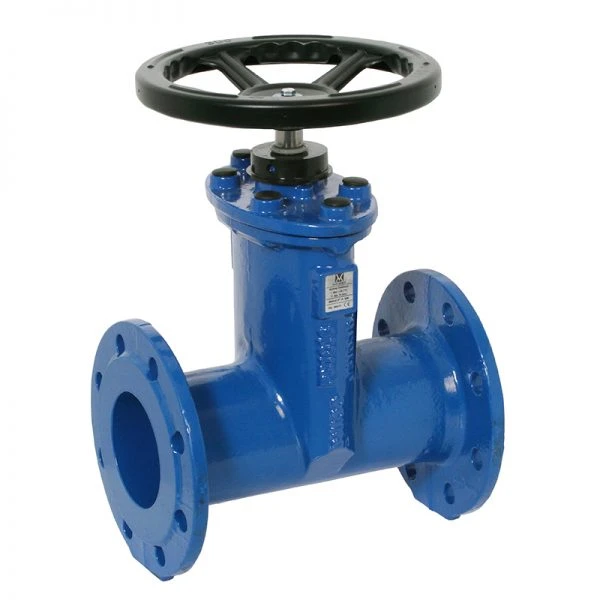
Resilient seat gate valves
- Body: ductile iron GGG40, epoxy-coated
- Gate: EPDM-encapsulated, full-bore
- DN 40–600, PN 10–16
- Flanged to EN 1092-1
- NRS or OS&Y versions
- Potable water approval (WRAS, KTW)
Wedge gate valves (cast)
- Body: cast iron GG25, bronze seats
- Body: ductile iron GGG40, SS seats
- DN 50–600, PN 16–25
- Flanged to EN 1092 or ANSI B16.1
- Steam to 250 °C, water, industrial fluids
- Rising stem (OS&Y) standard
Forged steel gate valves
- Body: carbon steel A105, SS 316
- DN 15–80, ANSI Class 150–2500
- SW, BW, screwed and flanged ends
- High-pressure steam, oil & gas, HPU
- Full and reduced bore options
- API 600 / BS 1414 design
Application sectors
Water utilities and fire protection
Resilient-seat gate valves are the standard isolation valve for municipal potable water distribution, wastewater treatment plants, pumping stations and fire protection mains. Their full-bore, debris-tolerant design makes them ideal for buried service with valve boxes, or for large-diameter above-ground pump isolations.
Steam and industrial process
Metal-seated and forged steel gate valves are used for steam isolation at boiler outlets, steam distribution headers and turbine inlet lines. Their multi-turn design prevents the water hammer that a quick-closing ball valve would cause in large steam mains. See also: choosing valves for steam systems.
Oil & Gas and petrochemical
Forged carbon and stainless steel gate valves designed to API 600 and API 602 are used in oil & gas process trains for isolation of crude oil, refined products, natural gas and associated process fluids at high pressures (ANSI Class 300–2500). NACE MR0175 trim available for sour service.
Industrial utilities and HVAC
Cast iron and ductile iron gate valves remain a cost-effective isolation solution for industrial plant utilities — compressed air headers, cooling water circuits, and heating hot water systems — where their full-bore design keeps pressure drop to a minimum on long distribution lines with multiple branches.
Frequently asked questions
What is the difference between a gate valve and a ball valve?
Can gate valves be used for flow regulation (throttling)?
What is the difference between rubber-seated and metal-seated gate valves?
What sizes and pressure ratings are available for gate valves?
When should I specify a rising-stem versus a non-rising-stem gate valve?
Request gate valve pricing
Tell us the size (DN), pressure class (PN or ANSI), design (resilient seat / wedge), body material and quantity. We respond within 24 hours with availability and pricing.