Check Valves (Non-Return Valves)

Automatic backflow prevention for water, steam, oil, compressed air and chemical service. Swing, dual-plate wafer, piston and non-slam types from DN 15 to DN 600.

The function of check valves

Check valves (also known as non-return valves, NRVs) are automatic valves that allow flow in one direction only, closing immediately when forward flow stops or reverses. Unlike other valve types, check valves require no operator intervention — they respond solely to flow dynamics and pressure differential. The forward pressure differential opens the valve; reverse pressure (or gravity, in some designs) closes it.

Check valves are essential protective devices in virtually every industrial piping system. They prevent: pump reverse rotation (when a centrifugal pump stops, backflow through the impeller can spin the shaft in reverse, damaging mechanical seals and bearings); contamination of clean water or process fluid from a downstream source entering the supply line; backflow in steam and condensate return systems (preventing live steam from reaching the condensate return pump); and reverse siphoning in chemical injection systems.

Roffia stocks check valves in all common types across a broad range of materials — from low-cost PVC check valves for chemical service to large-diameter ductile iron dual-plate wafer valves for water treatment pumping stations, and stainless steel lift check valves for steam condensate return lines.
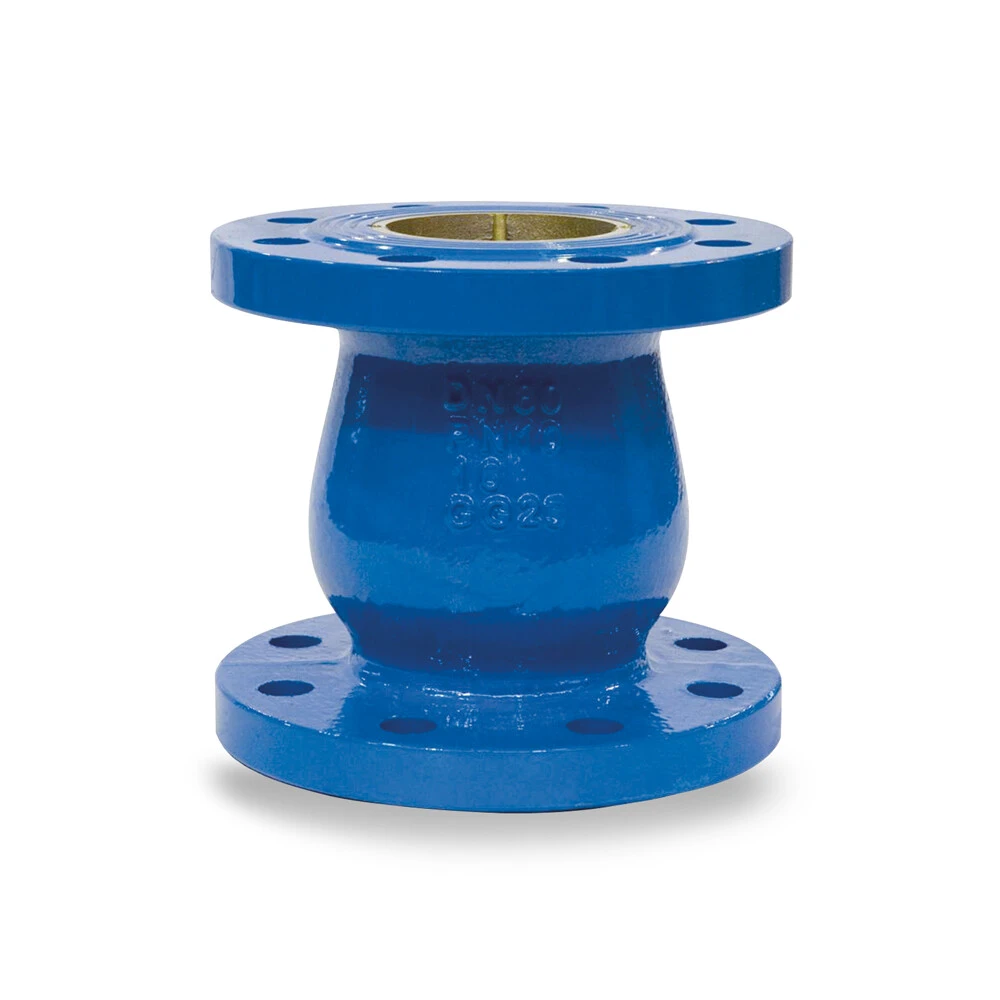
Check valves non-return valves — Roffia srl

Swing check

Hinged disc. Low cracking pressure. Water, gravity drainage, large pipes. Horizontal or vertical up-flow. Risk of water hammer at high velocity.

Piston (lift) check

Guided piston on seat. Compact, fast-closing. Steam, compressed air, vertical up-flow. Spring-loaded versions for any orientation.

Dual-plate wafer

Spring-loaded half-plates. Very compact (wafer body). Fast-closing, low pressure drop, any orientation. Pump discharge, HVAC, water treatment.

Non-slam (silent)

Spring-assisted closure before flow reversal. Zero water hammer. Pump discharge protection, boiler feed, sterile process. Higher cost, all orientations.

Materials and applications guide

Material DN range Recommended for
Brass / BronzeDN 15–80Water, steam to PN 16, heating systems
Cast iron GG25DN 40–300Water utilities, HVAC, low-pressure industrial
Ductile iron GGG40DN 50–600Water treatment, pumping stations, fire mains
Stainless steel AISI 316DN 15–300Steam, condensate, chemical, food, pharmaceutical
PVC-U / PVDFDN 15–200Aggressive chemicals, chlorinated water, acids

Frequently asked questions

What types of check valves are available and how do they differ?
Check valves (also called non-return valves) prevent backflow and are available in several designs, each suited to different applications: Swing check valves use a hinged disc that swings open with forward flow and closes by gravity and back-pressure when flow stops or reverses. Suitable for horizontal or vertical (upward-flow) installation. They require zero external pressure drop to open, making them ideal for low-pressure water and wastewater systems, but they close slowly (risk of water hammer in high-velocity systems). Piston (lift) check valves have a guided plug or piston that lifts off its seat with forward flow and reseats by gravity/spring when flow stops. Compact, suitable for vertical installation, fast-closing, good for steam and viscous fluids. Dual-plate (Wafer) check valves are compact, wafer-body valves with two spring-loaded half-discs. Very fast closure (spring-assisted), low pressure drop, suitable for high-velocity and pump discharge applications where water hammer must be minimised. Non-slam (silent) check valves use a spring to assist closure before flow reversal occurs, eliminating water hammer entirely. Ideal for pump suction and discharge lines. Roffia stocks all types in materials from DN 15 to DN 600.
What is water hammer and which check valve helps prevent it?
Water hammer (hydraulic shock) occurs when a fluid in motion is suddenly stopped or forced to change direction — the kinetic energy converts to a pressure wave that can be intense enough to rupture pipes, damage fittings and damage check valves themselves. Slow-closing check valves (swing type) allow reverse flow to develop before closing, and the sudden slam creates a hammer impact. To prevent this, specify either: non-slam (silent) check valves — spring-loaded to close before reverse flow develops; or dual-plate/wafer check valves — the two spring-loaded half-plates close extremely quickly (milliseconds rather than seconds). For critical pump discharge protection where any backflow could cause pump damage (centrifugal pump back-spinning), non-slam check valves or dual-plate valves are specified as standard. Roffia recommends these types for boiler feed pump discharge lines, chiller pump circuits and treated water distribution systems.
Can check valves be installed in vertical pipework?
It depends on the check valve type and the flow direction. Swing check valves (disc hinged at the top) can be installed vertically only in upward-flow orientations — gravity assists closure when flow stops. They cannot be used on downward-flow vertical lines, as gravity would hold the disc open. Piston lift check valves are specifically designed for vertical upward-flow installation — the piston drops back onto the seat when flow stops, giving a positive gravity-assisted closure. Dual-plate wafer check valves can be installed in any orientation (horizontal, vertical up, or vertical down) because the spring loading is sufficient to close the plates regardless of gravity direction. When specifying a check valve, always state the installation orientation and flow direction to ensure the correct type is selected. Roffia's team advises on correct type selection for your installation.
What is the difference between a check valve and a foot valve?
A foot valve is essentially a check valve installed at the inlet end of a pump suction pipe, submerged in the liquid source (well, sump, tank). Its purpose is twofold: (1) it prevents backflow — keeping the suction pipe primed with liquid when the pump is stopped, so the pump does not need to be re-primed before each start; (2) it includes a strainer screen at the inlet to prevent large solids from entering the suction pipe and damaging the pump impeller. Foot valves are used with centrifugal and reciprocating pumps drawing from open sumps, wells or storage tanks. They are available in PVC, bronze and cast iron; the strainer mesh size varies depending on the pump's solid-handling capability. Check valves, by contrast, can be installed anywhere in the pipe system where backflow prevention is needed — not necessarily at the suction entry point.

Source the right check valve

Tell us fluid type, DN, PN, installation orientation, flow velocity and any special requirements (steam, food-grade, ATEX). We will recommend the optimum check valve type and material.

Privacy Policy Cookie Policy