Industrial Butterfly Valves
Compact, lightweight and versatile — butterfly valves from DN 40 to DN 600 for reliable isolation and throttling in water, HVAC, fire protection and industrial process systems.
How butterfly valves work
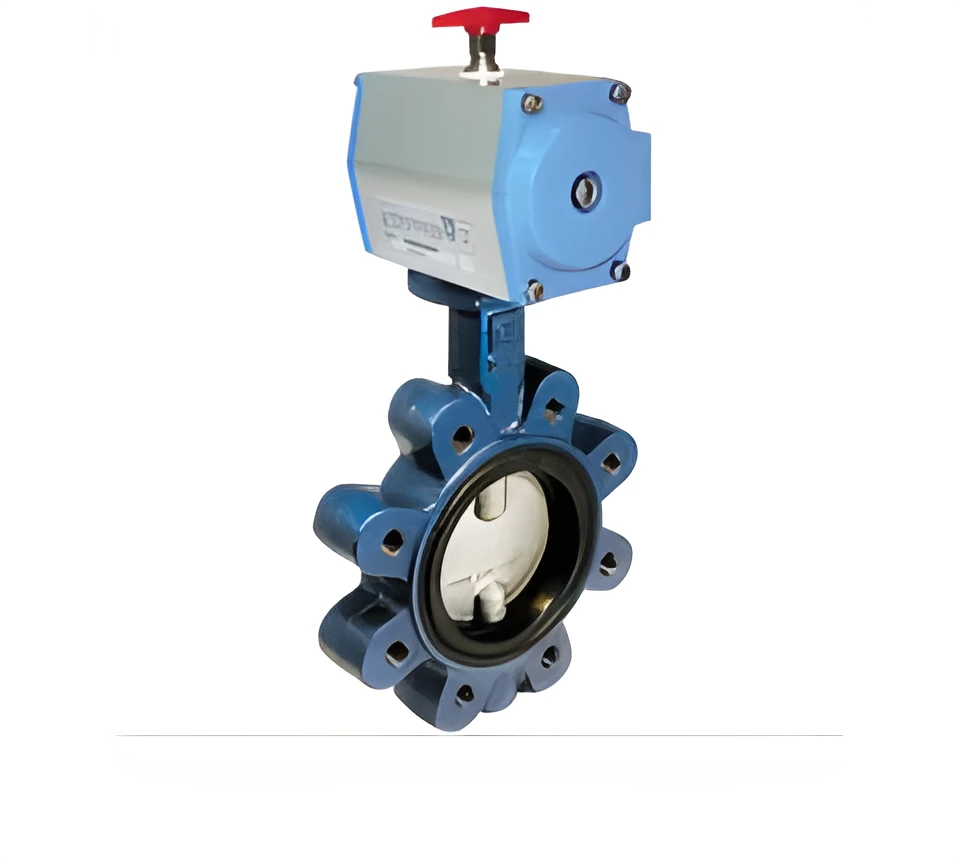
A butterfly valve controls fluid flow by means of a circular disc (or vane) mounted on a shaft running through the center of the pipe. Rotating the disc 90° from perpendicular to the flow axis (closed) to parallel with the flow (open) allows the full pipe bore to carry flow. The disc remains permanently in the flow stream even when fully open, contributing a small but measurable pressure drop compared to a ball or gate valve — typically expressed as a loss coefficient K or as a flow factor Kv.
Butterfly valves are available in three main design styles ranked by performance and cost: concentric (rubberliner seat, general purpose), double-offset high-performance (HP) (metal seat, improved sealing, longer life) and triple-offset (zero friction sealing, metal-to-metal seat, suitable for high temperature and critical service). Roffia stocks all three types, from economical concentric valves for water distribution up to triple-offset valves for steam and thermal oil.
A key advantage of butterfly valves over ball or gate valves is weight and space saving: a DN 400 butterfly valve weighs a fraction of the equivalent gate valve and requires far less face-to-face installation space. This makes them the preferred choice for large-diameter applications in water treatment plants, fire protection mainlines and process piping.
Body materials
- Ductile iron GGG40 — standard, water & HVAC
- Cast iron GG25 — economical, low-pressure water
- Stainless steel CF8M — corrosion resistance, food, chemical
- Carbon steel WCB — high pressure, industrial process
- PVC — chemical resistance, smaller diameters
Liner and seat materials
- EPDM — hot water, steam to 120 °C, HVAC
- NBR — oil-based fluids, diesel, lubricants
- NR (natural rubber) — abrasive slurries, mining
- PTFE — aggressive chemicals, hygienic service
- Metal / Stellite — high temp, fire-safe, steam
Standards and certifications
- EN 593 — industrial butterfly valves
- API 609 — lug and wafer butterfly valves
- PED 2014/68/EU — CE pressure equipment
- EN 12266-1 — leakage testing
- FM / UL — fire protection service
Main applications
Water treatment and distribution
Ductile iron butterfly valves with EPDM liners are the workhorse of municipal and industrial water treatment plants, pumping stations and distribution networks. Their large-bore capability at reasonable cost and weight makes them the most economical isolation valve for diameters above DN 150.
HVAC and building services
Motorised (electric and pneumatic actuated) butterfly valves are used extensively in heating, cooling and ventilation systems for zone control, AHU coil isolation, chiller and heat pump circuits, and balancing in large commercial and industrial buildings. Integration with BMS via 0–10 V or Modbus is standard.
Fire protection
Lug butterfly valves with UL/FM approval are used in fire protection systems (sprinkler and foam) as isolation valves on water mains, allowing fast visual indication of valve position and tamper-proof supervisory switches. Approval to EN 1074-6 and UL 1091.
Industrial process and chemical industry
High-performance double-offset or triple-offset butterfly valves in stainless steel with PTFE or metal seats are specified for aggressive chemical service, pharmaceutical manufacturing, thermal oil circuits and high-temperature process lines where a concentric design would not achieve the required service life or leakage class.
Frequently asked questions
What is the difference between wafer-style and lug-style butterfly valves?
Can butterfly valves be used for throttling and flow regulation?
What disc and liner materials are available for butterfly valves?
What sizes and pressure ratings do butterfly valves cover?
How do I choose between a manual, electric and pneumatic butterfly valve?
Need butterfly valves?
Specify DN, PN, body material, liner/seat material, end connections (wafer/lug/flanged) and actuation (manual/electric/pneumatic). We will confirm availability and cost within 24 hours.