Industrial Ball Valves
Quarter-turn, bubble-tight shut-off valves for steam, water, air, oil, gas and chemical service. Full-bore, fire-safe, ATEX and PED-certified versions from stock.
What are industrial ball valves?
Ball valves are quarter-turn rotary valves in which a drilled spherical plug (the "ball") controls flow by rotating 90° between the fully open and fully closed positions. When open, the bore of the ball aligns with the pipe bore, providing a straight, unobstructed flow path. When closed, the solid part of the ball blocks the flow completely, delivering a bubble-tight shut-off (Class VI leakage to EN 12266-1 or ANSI/FCI 70-2).
Ball valves are the most widely used industrial valve type for isolation and block-and-bleed duty because of their speed of operation (quarter turn = 1/4 of a revolution), low pressure drop, compact dimensions and long service life. They are available in sizes from DN 6 (¼") to DN 300 (12") and beyond in special orders, with pressure ratings from PN 6 to PN 100 (ANSI Class 150 to 2500).
Roffia stocks thousands of ball valves in its Cremona warehouse, covering the most common specifications for immediate dispatch throughout Italy and Europe. Whether you need a simple brass 1" valve for a compressed-air line or a fully PED-certified DN 100 stainless steel fire-safe ball valve for a chemical process, our technical team can identify and deliver the right product quickly.
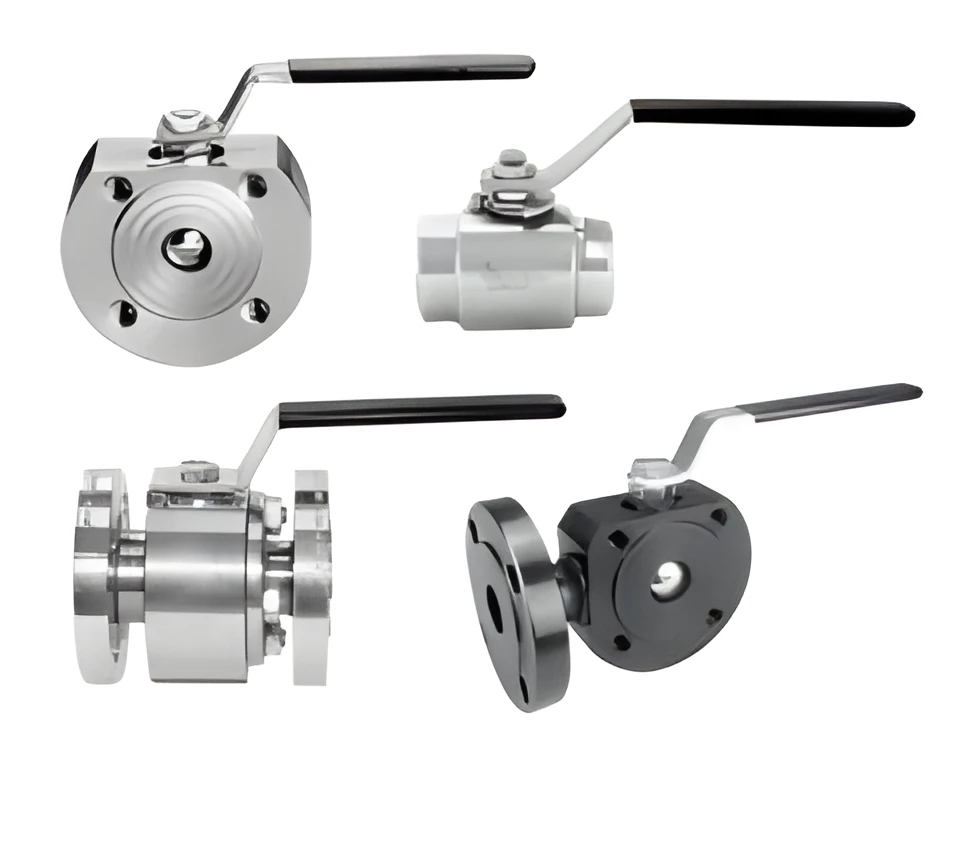
Available body materials
- Brass CW617N — economical, for water, air, natural gas (PN 16–40)
- Stainless steel CF8M / AISI 316 — corrosion resistance, food, pharma, steam
- Carbon steel A216 WCB / A105 — high pressure steam, oil & gas
- Duplex / Super Duplex — offshore, seawater, chloride environments
- PVC-U, PP, PVDF — chemical service, aggressive fluids
Seat and seal materials
- PTFE — standard, wide chemical compatibility, up to 180 °C
- RPTFE (reinforced) — improved mechanical resistance
- PEEK — high temperature (up to 260 °C), steam service
- Metal seats (SS / Stellite) — fire-safe, abrasive media, high temperature
- EPDM, NBR, Viton — specific fluid compatibility
Certifications and standards
- PED 2014/68/EU — Pressure Equipment Directive (CE marking)
- API 607 / API 6FA — fire-safe performance
- ATEX 2014/34/EU — explosive atmospheres (anti-static)
- EN ISO 17292 — metal ball valves for petroleum and allied industries
- API 6D — pipeline ball valves
Main applications of ball valves
Utility and HVAC systems
Brass and stainless steel ball valves are the standard isolation valve for hot and cold water distribution, HVAC circuits, compressed air, inert gases and low-pressure steam. Their quarter-turn operation makes them ideal for quick manual isolation; motorised (electric or pneumatic) actuated versions are used for remote operation and building management systems (BMS).
Steam and condensate systems
Stainless steel and carbon steel ball valves are used extensively in steam distribution systems for isolation duties at boiler headers, heat exchanger inlets and branch lines. Full-bore design is preferred to facilitate system pigging and minimise pressure loss in long steam mains.
Oil & Gas and biogas
Fire-safe, ATEX-certified ball valves in carbon or duplex stainless steel are required in oil & gas process lines, LPG storage facilities and biogas plants. API 6D and API 607 certification ensures suitability for safety-critical isolation duty. Trunnion-mounted designs are preferred for larger sizes (DN 100+) to reduce operating torque and ensure consistent sealing under high pressure differentials.
Chemical and pharmaceutical industry
The chemical and pharmaceutical sector requires ball valves in AISI 316L stainless steel with PTFE seats and packing for aggressive media. In highly corrosive or ultra-pure fluid applications, PVDF or Hastelloy bodies are specified. Roffia can source special alloy valves on request with material test reports (MTRs) and full documentation packages.
Ball valve configurations stocked by Roffia
DN 6–150, standard design
DN 50–300, high-pressure duty
Easy seat replacement in-line
In-line maintenance without removal
Flow diversion or mixing
DN equal to pipe bore, zero pressure drop
Flush-bottom draining from vessels
Heated body for viscous/solidifying fluids
Frequently asked questions
What is the difference between full-bore and reduced-bore ball valves?
Which ball valve materials are suitable for steam service?
What does "fire-safe" mean for a ball valve, and when is it required?
What is an ATEX-rated ball valve and when is it needed?
How do I size a ball valve for my application?
Request a ball valve quote
Send us your specifications: fluid type, DN, PN/ANSI class, material, temperature, end connections and any certification requirements. We will confirm stock availability and provide a competitive quotation within 24 hours.