Air Vents and Vacuum Breakers
Essential devices for proper functioning of heating and hydraulic systems. They eliminate trapped air, prevent corrosion, avoid noise and circulation blockages. They protect pipework from collapse during draining.
Why eliminate air from systems
Air is the invisible enemy of hydraulic and heating systems. It enters during filling, is released from heated water (gas solubility decreases with temperature) and penetrates through permeable components. Once in the system, air causes annoying noise (gurgling, water hammer), reduced thermal efficiency (air pockets in heat exchangers), accelerated corrosion (oxygen attacks ferrous metals) and in worst cases complete circulation blockage (airlock).
Automatic air vents solve these problems by continuously expelling air that accumulates at high points. Vacuum breakers perform the complementary function: they allow air to enter when a vacuum develops (during draining or rapid cooling), preventing pipe collapse and facilitating drainage.
Roffia distributes a complete range of air vents, vacuum breakers and air separators from Caleffi and Spirax Sarco, for civil and industrial systems up to steam applications.
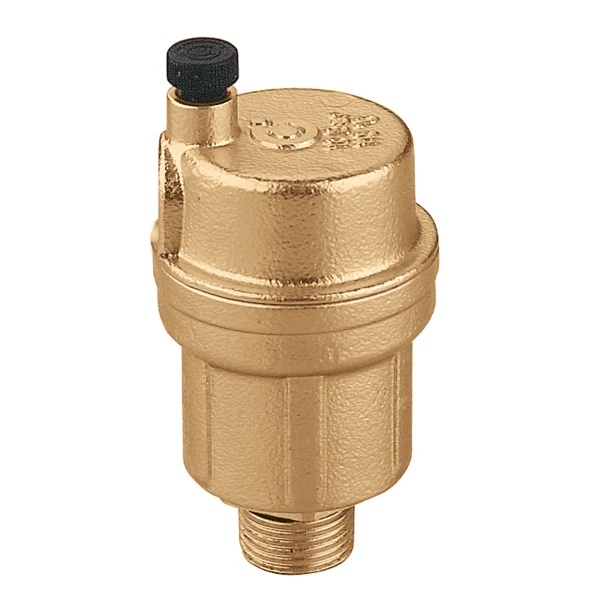
Automatic air vents
- Internal float opens/closes vent
- Fully automatic operation
- Body in brass, steel or stainless steel
- DN 10–25 (½"–1"), PN 10–16
- Temperature up to 110 °C (standard)
- High-temperature versions for steam
Vacuum breakers
- Prevents pipe collapse under vacuum
- Facilitates circuit draining
- Combined with air vent (dual function)
- Essential on heat exchangers and tanks
- Body in brass or stainless steel
- DN 15–50
Air separators (de-aerators)
- Remove dissolved air and microbubbles
- Body with coalescence elements
- Integrated automatic vent
- DN 20–150, in-line installation
- Reduce corrosion and cavitation
- For efficient heating systems
Air vents for steam systems
- Thermostatic vents — expel cold air at start-up
- For steam lines — steel or stainless body, high temperature
- For heat exchangers — prevent air pockets in tube bundle
- Brands: Spirax Sarco, ARI, Gestra
- Essential for steam system efficiency
Manual bleed valves
- Bleed cocks — for radiators and terminals
- Handwheel valves — manual air discharge in plant room
- Bleed keys — accessory for radiator venting
- Economical, but require manual intervention
- Complement automatic vents at terminal points
Typical applications
Heating systems
Automatic air vents at the top of each riser, on boilers and cylinders, at headers and heat exchangers. Air separators on the primary circuit (hot side, after boiler) remove air released by heating before it reaches terminals. Result: always-hot radiators, no gurgling, reduced corrosion.
Chilled water circuits
Chilled water circuits also suffer from trapped air. Air vents at high points and separators in the plant room ensure maximum efficiency of fan coils and cooling coils. Vacuum breakers prevent collapse during seasonal draining.
Steam distribution networks
At start-up of a steam system, the lines are full of cold air that must be expelled before steam can reach them. Thermostatic (thermal) air vents open while cold air exits and close automatically when hot steam arrives. Installation: high points, line ends, heat exchanger inlets.
Tanks and vessels
Vacuum breakers are essential on tanks, autoclaves and shell-and-tube heat exchangers. During rapid draining or cooling, internal vacuum could cause structural collapse. The vacuum breaker allows air in, equalising pressure and avoiding costly damage.
Roffia air vent and vacuum breaker range
Brass and stainless, DN 10–25
For circuits up to 150 °C
Thermostatic Spirax Sarco
Single and combined
Caleffi Discal, DN 20–150
For critical circuits
Bleed cocks, handwheel
Isolation valves, caps
Frequently asked questions
What is the difference between an air vent, a bleed valve and a vacuum breaker?
Why is air in the system a problem?
Where should air eliminators be installed?
What is an air separator and when is it needed?
How often should an automatic air vent be checked?
Request a quote for air vents and vacuum breakers
Please provide system type, operating temperature and pressure. We will recommend the correct device — air vent, vacuum breaker or separator — with a prompt quotation.