Plate Heat Exchangers
Compact, highly efficient and easy to maintain. Gasketed and brazed plate exchangers for steam heating, pasteurisation, DHW production and energy recovery — with free sizing service from Roffia technical team.
How plate heat exchangers work
A plate heat exchanger consists of a series of corrugated metal plates clamped between a fixed and a movable frame. The two fluids flow on alternate sides of the plates — always in counterflow to maximise the temperature difference across the heat transfer surface. The corrugated pattern forces turbulent flow at much lower velocities than tubular exchangers, achieving heat transfer coefficients 3–5 times higher than shell-and-tube designs of comparable duty.
This translates to significantly smaller footprints — a plate exchanger rated at 500 kW may occupy less than a quarter of the floor space of an equivalent tubular unit. The gasketed version can be fully dismantled for inspection and cleaning, or expanded by adding plates as the process duty grows. The brazed version is permanently sealed, extremely compact and cost-effective for fixed-duty applications.
For steam-heated applications, plate exchangers are typically the first choice in food, pharmaceutical and HVAC sectors. They require correct float steam trap sizing and careful air venting at startup to achieve rated performance.
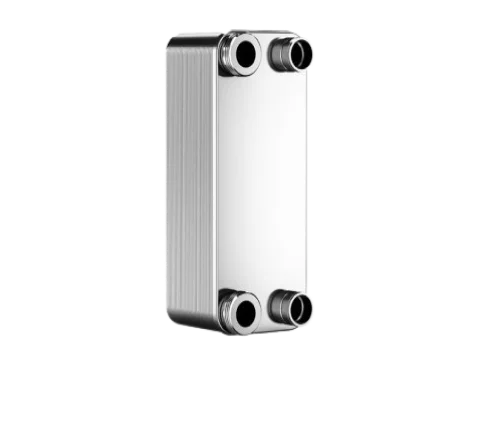
Gasketed plate heat exchangers
- Temperature range: –20 °C to +185 °C (EPDM gaskets)
- Max pressure: up to 25 bar
- Plates: AISI 316L, titanium, Hastelloy C-276
- Gaskets: NBR, EPDM, HNBR, PTFE
- Duty: 1 kW to several MW
- Key advantage: fully dismantlable, expandable, cleanable
Brazed plate heat exchangers
- Temperature range: –160 °C to +225 °C
- Max pressure: up to 30–45 bar (nickel-brazed)
- Plates: AISI 316L (copper- or nickel-brazed)
- Duty: typically below 200–500 kW
- Key advantage: no gaskets, no frame, very compact and lightweight
- Note: not suitable for fouling fluids or CIP cycles
Typical applications
Steam heating and pasteurisation
In the food and beverage sector, gasketed plate exchangers heat milk, juices and liquids from process steam. EPDM or HNBR gaskets and electropolished AISI 316L plates meet 3-A Sanitary Standards and EHEDG guidelines. CIP cleaning is fully supported. For pasteurisation duties, the exchanger must maintain the required holding temperature; this involves precise sizing and steam trap selection to avoid condensate flooding.
District heating substations
In district heating networks, plate exchangers interface the primary network (high temperature, often 70–130 °C) with the building's secondary heating circuit. They provide hydraulic isolation between networks, are compact enough for small plant rooms and their high heat transfer efficiency minimises the primary return temperature — important for heat pump-assisted networks and biomass boiler efficiency.
Domestic hot water production
Brazed plate exchangers are the standard solution for instantaneous DHW production in boiler rooms and heat pump installations. Their very small water content means near-instant hot water response within seconds of demand. WRAS-approved versions are specified for direct potable water contact in the UK and equivalent certifications apply across EU markets.
Biogas and energy recovery
In biogas plants, plate exchangers recover heat from engine cooling water and CHP exhaust to heat the anaerobic digesters. The biogas slurry side may contain fibres and particulates — appropriate plate spacing (wide-gap or free-flow designs) and regular inspection are required. Titanium plates are often specified where the digestate is mildly corrosive.
Data required for sizing
Process data (both sides)
Fluid type, inlet and outlet temperatures, mass flow rate or duty (kW), operating pressure and maximum allowable pressure drop.
Fluid properties
For non-aqueous fluids: viscosity, specific heat and thermal conductivity at operating temperature. For steam: saturation pressure and whether steam is dry saturated or superheated.
Fouling factors
Expected fouling resistance for each fluid (TEMA values or process-specific). Critical for correct oversizing and maintenance interval planning.
Regulatory and connection requirements
PED category, food-grade certification requirements, connection sizes (DN, flange standard) and frame orientation (horizontal or vertical installation).
Domande frequenti
What is the difference between a gasketed and a brazed plate heat exchanger?
What does plate corrugation pattern affect in a plate heat exchanger?
Which materials are available for plates and gaskets?
How do I size a plate heat exchanger?
Can a plate heat exchanger handle steam on one side?
How often do plate heat exchanger gaskets need replacing?
Plate heat exchanger sizing service
Send us your process data — fluids, temperatures, flow rates and pressures — and our technical team will return a plate selection with a detailed quotation. No obligation.